The Last Time It Feels Like the First Time
The first morning of build week, I walked out onto the field at Nissan Stadium the same way I've done it twelve times before. The terratrack is down. There's gear staged everywhere, guys in hard hats moving in a dozen different directions, and somewhere between the dock ramp and the production office there's a problem that needs solving before 8 AM. All of it exactly as expected.
But this year, for the first time, I stood there and let myself think: this is the last time.
The new Tennessee Titans stadium opens in 2027. CMA Fest goes with it. The Nissan Stadium era of the Main Stage — thirteen years of it, for me — ends with this show. And whether you're the kind of person who gets sentimental about buildings or not, that sits with you differently when you've spent a meaningful piece of your career figuring one out.
This isn't a recap of the shows. It's a look at what thirteen years in one venue actually looks like from the production side — what changed, what the building taught us, and what we're carrying into whatever comes next.
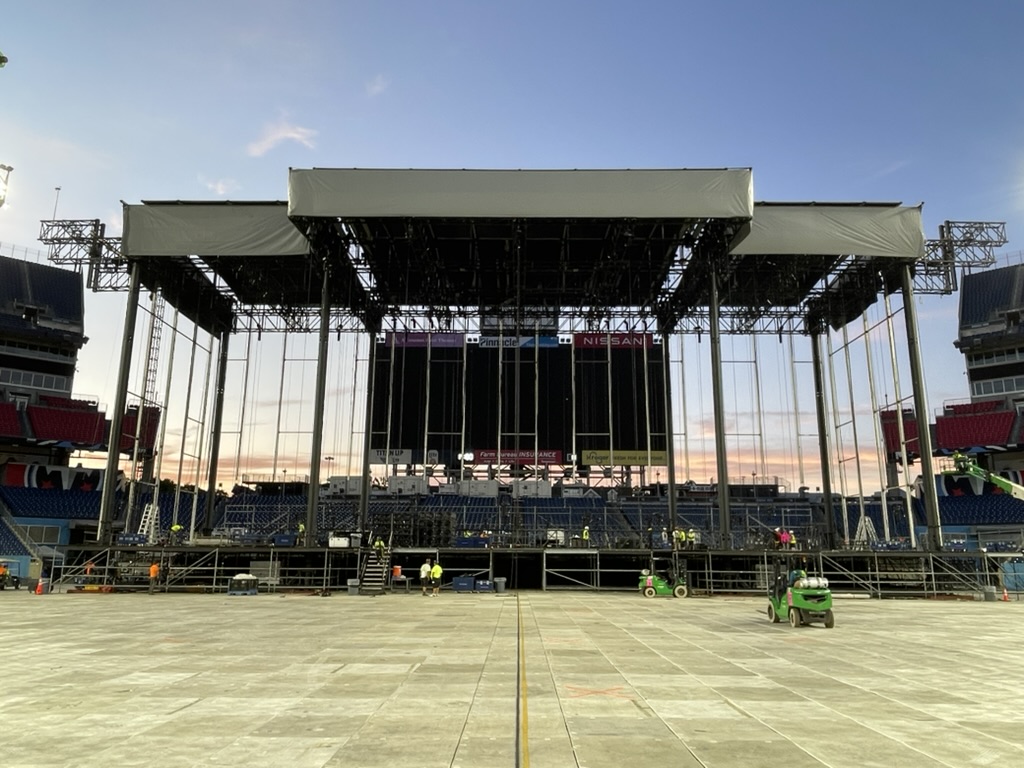
The view from underneath — trusses, cables, and a lot of rigging that has to be perfectly right before any of it flies.
Year One: A Blank Canvas That Felt Impossible
In 2012, I came to CMA Fest at Nissan Stadium for the first time as the Production Coordinator for the Main Stage. I had done stadiums before. I had worked big events. But I had never approached a build of this scale from a completely blank canvas — walking into an empty football field and being partially responsible for turning it into a fully operational concert venue capable of running four days of back-to-back shows.
That year we had twenty-four artists performing over four days. One stage. The field still had grass.
I remember standing on that grass on day one of build week and genuinely wondering if we were going to get it done in time. The scale of what had to happen before the first artist took that stage felt like it should take longer than we had. Equipment coming in from multiple vendors, labor calls to coordinate, cranes moving overhead, and a list of details that multiplied every time you crossed one thing off it.
We got it done. And then we did it again the next year. And the year after that. Thirteen times total, and that feeling of "how is this all going to come together" never fully went away — which I've come to think is actually healthy. The moment you stop feeling the scale of what you're doing is probably the moment you start making assumptions.
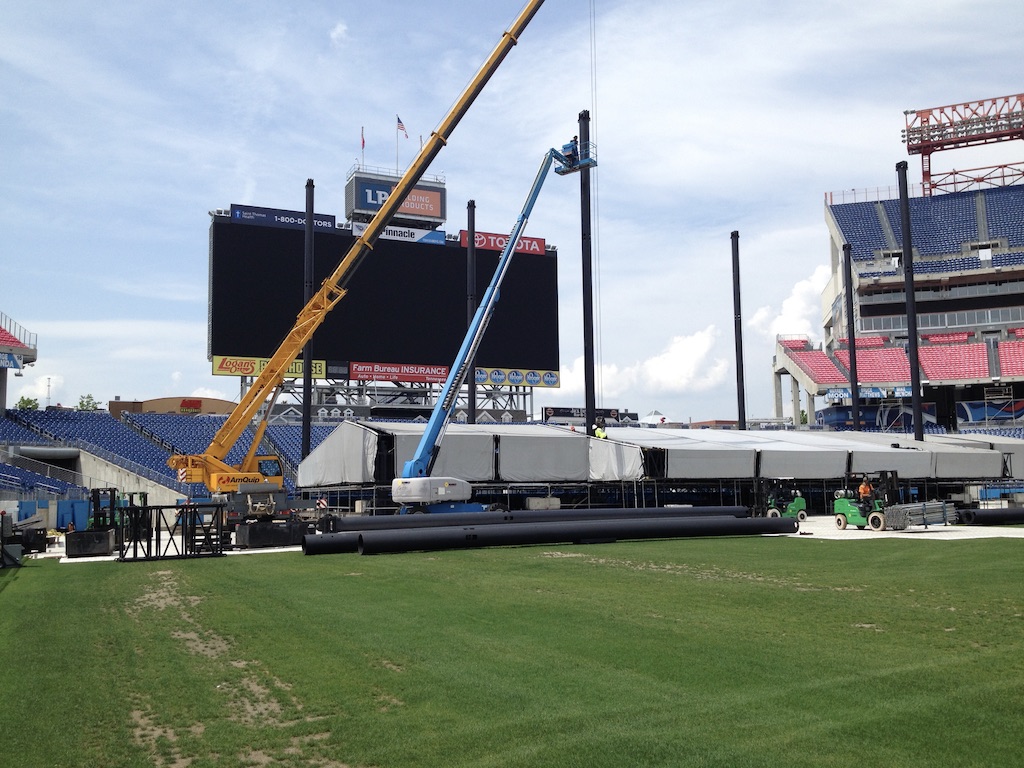
Early years — the field still had grass, and the stage and field footprint looked nothing like what it would eventually become.
The Field Itself Changed Everything
The single biggest operational shift in thirteen years wasn't technology. It wasn't the production scale. It was the grass.
Nissan Stadium installed artificial turf in 2018, and for an event like CMA Fest, that changed the entire playbook. When the field was grass, our footprint was constrained. You couldn't run heavy equipment across the playing surface without risking damage to the turf, which meant load-in routes and equipment staging had to work around that limitation. Every truck, every forklift, every crane — you were thinking about what the field could take.
With turf, we moved to covering the entire field with terratrack, not just the stage area. That's a full field of interlocking panels creating a level, stable surface from end zone to end zone. Safer for the audience walking in. Completely serviceable for the equipment we're running — trucks, forklifts, cranes all operating on the same surface without concern for what's underneath.
"When you cover the whole field, you stop compromising. Everything runs better — trucks, crew, crowd flow. It's one of those changes you don't fully appreciate until you've worked both ways."
It sounds like infrastructure. It is infrastructure. But it's the kind of infrastructure change that has a downstream effect on almost every department. Load-in routes improved. Crane access improved. The overall build efficiency got better because we weren't routing everything around a protected surface. Small operational details that compound across four days and thirty-nine artists.
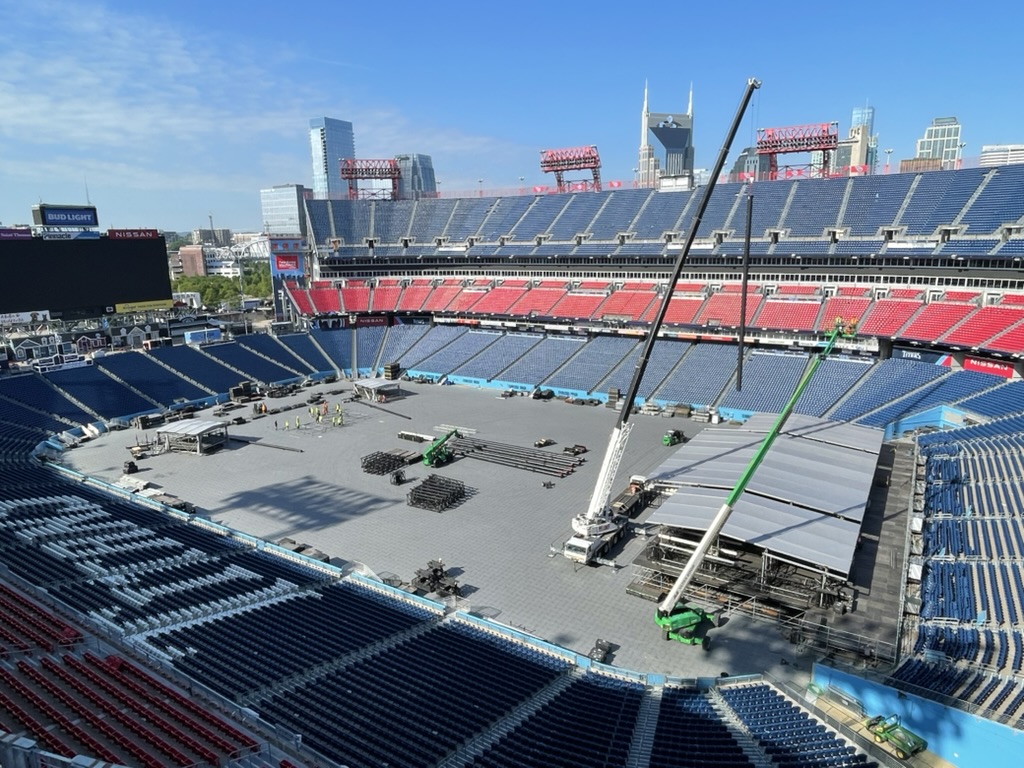
Mid-build, the stage canopy structure going up. The terratrack floor covers the full field — a very different picture from the early grass years.
Five Loading Docks. Twenty-Four Acts.
Here's something the average CMA Fest attendee will never think about: Nissan Stadium has five loading docks.
Five. For a 69,000-seat NFL facility that hosts one of the biggest music events in the country every year.
The building was designed for football. Entertainment was, at best, a secondary consideration. And that design philosophy shows up most clearly in the dock situation. Five docks means that every truck movement — and we're talking about 53-foot semi trailers, multiple vendors, multiple departments, multiple artists — has to be choreographed through five access points.
It's not just the number of docks. It's the geometry. To get a truck into position, the driver has to back down approximately 150 feet of ramp into what amounts to a dark hole, then navigate between giant concrete pillars to find their dock position. If you've never watched a veteran truck driver put a 53-footer into that position, it's impressive every time. If you've ever watched a driver who hasn't done it before try to figure it out at 7 AM during load-in, you understand why experience matters.
Over thirteen years, we developed a dock management system that works — a sequence for who goes in when, how long they have, and how the rotation moves to keep everything flowing. That's not in a manual anywhere. That's institutional knowledge built up from thirteen years of doing it, watching what broke, and fixing it the next year.
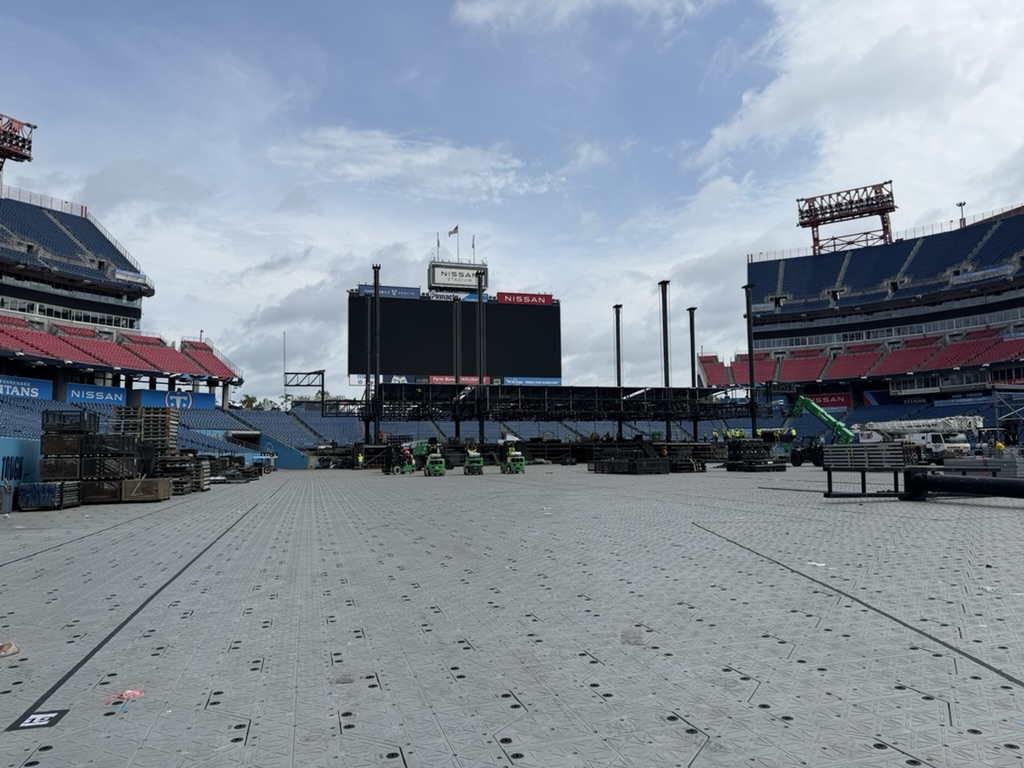
What load-in actually looks lik . Every cable run, every case, every access point has to be planned before the first artist truck arrives.
From One Stage to Three — How the Scale Changed
In 2012: twenty-four artists, four days, one stage.
In 2026: thirty-nine artists, four days, three stages — all inside Nissan Stadium.
The crew size stayed roughly comparable over the years, which tells you how much more efficiently we learned to use the building and how production workflows improved. You don't add fifteen artists and two stages and run the same number of crew without getting significantly better at the job.
But the production technology is what changed most visibly. Lighting and video components exist now that weren't even concepts fifteen years ago. LED technology alone has transformed what a headliner's production looks like from a distance — the scale of the screen walls, the resolution, the control systems managing it all in real time. The first year I was here, what was considered a high-end stage package looks modest by comparison to what the artists are bringing in now.
The FOH configuration evolved too. We moved to a split setup with lighting control positioned house right and audio positioned house left. That's a practical decision that came from years of figuring out sightlines, cable runs, and how to keep two of the most demanding departments from stepping on each other in a shared pit. It works. But it took a while to get there.
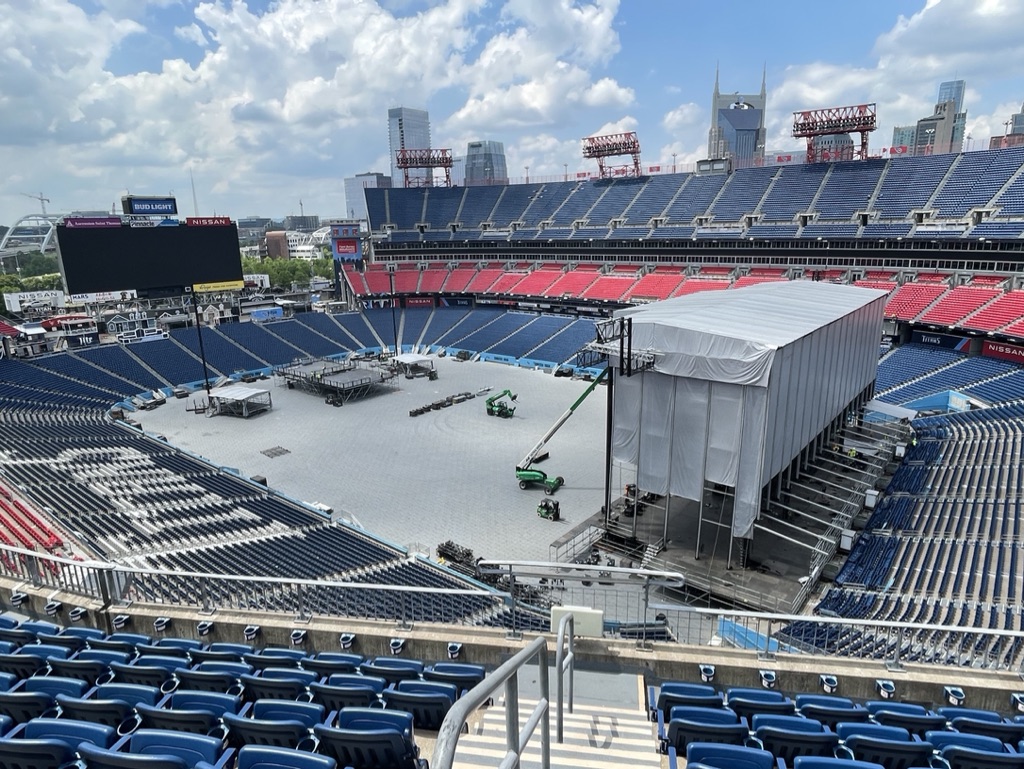
The Nashville skyline from the upper deck during build week — one of the better views in the business.
What Thirteen Years in One Building Actually Teaches You
There's a version of experience that's about accumulating time. And then there's a version that's about accumulating specific knowledge of a specific place.
After thirteen years at Nissan, I know things about that building that you cannot learn any other way. I know which docks have clearance issues for oversized loads and which ones don't. I know the sequence that works for loading in and out, and the sequence that looks like it should work but creates a problem three steps down the road. I know how the building behaves in the heat, and how the crew is going to feel by day three of a four-day run at 95 degrees in June in Nashville.
None of that is in the building's spec sheet. You can't advance it by making phone calls. It's the product of repetition — doing the same show in the same building enough times that the building stops surprising you, and you start anticipating it.
That's what you lose when you move to a new venue. Not the general skills, not the experience — those transfer. What you leave behind is the invisible map you built up over years of navigating the place. In 2027, we start building that map again from scratch.
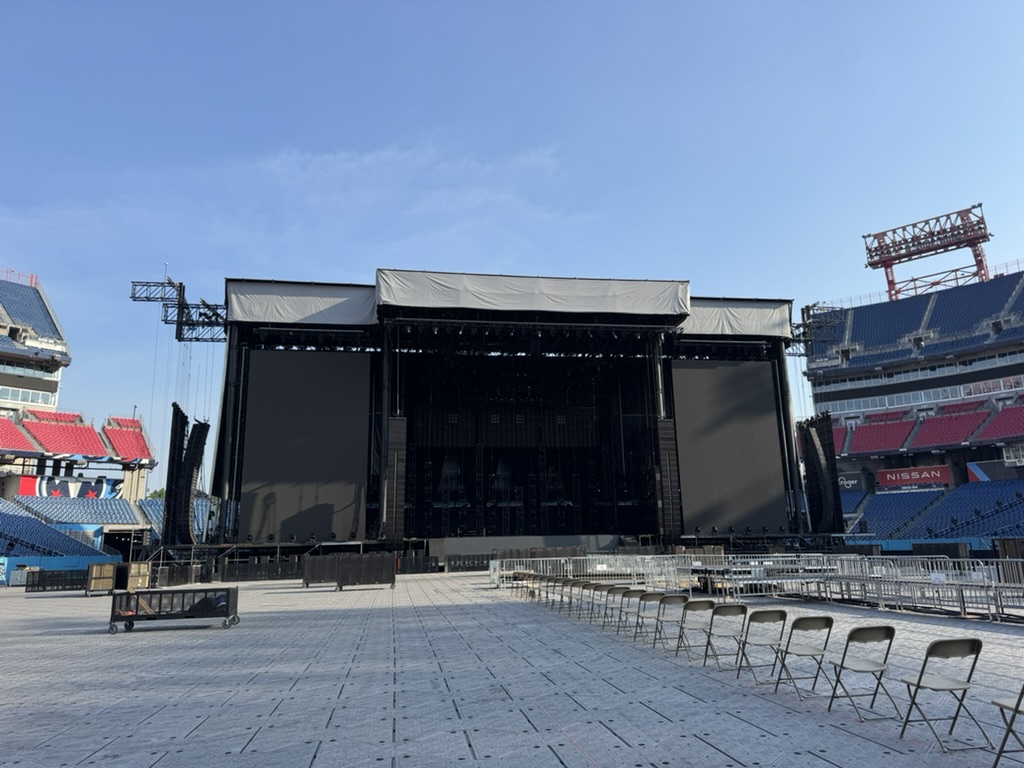
Stage complete, chairs going out, screens hung. Everything that had to happen in the last 72 hours is done. This is what the work looks like when it goes right.
Show Week
People ask what CMA Fest looks like from the production side. The honest answer is that if everything is working the way it should, you shouldn't see much of it at all. The show should look effortless from the audience. Seamless transitions, acts on and off on time, no gaps in the experience. The production infrastructure should be invisible.
What's actually happening behind that seamless experience is a relentless operation. Artists arriving, getting oriented, sound checking and clearing so the next act can come in. Stage managers calling transitions to the second. Audio engineers resetting for the next input list before the current act is off the stage. Lighting and video crews running changeovers. All of it on a clock, four days straight.
By year thirteen, the team operating this is elite. These are people who have done CMA Fest before, know what to expect, and execute at a level that makes the complexity look manageable. That's not an accident. That's years of building relationships with the right crew members, understanding who performs at their best under pressure, and putting people in positions where they can do what they do.
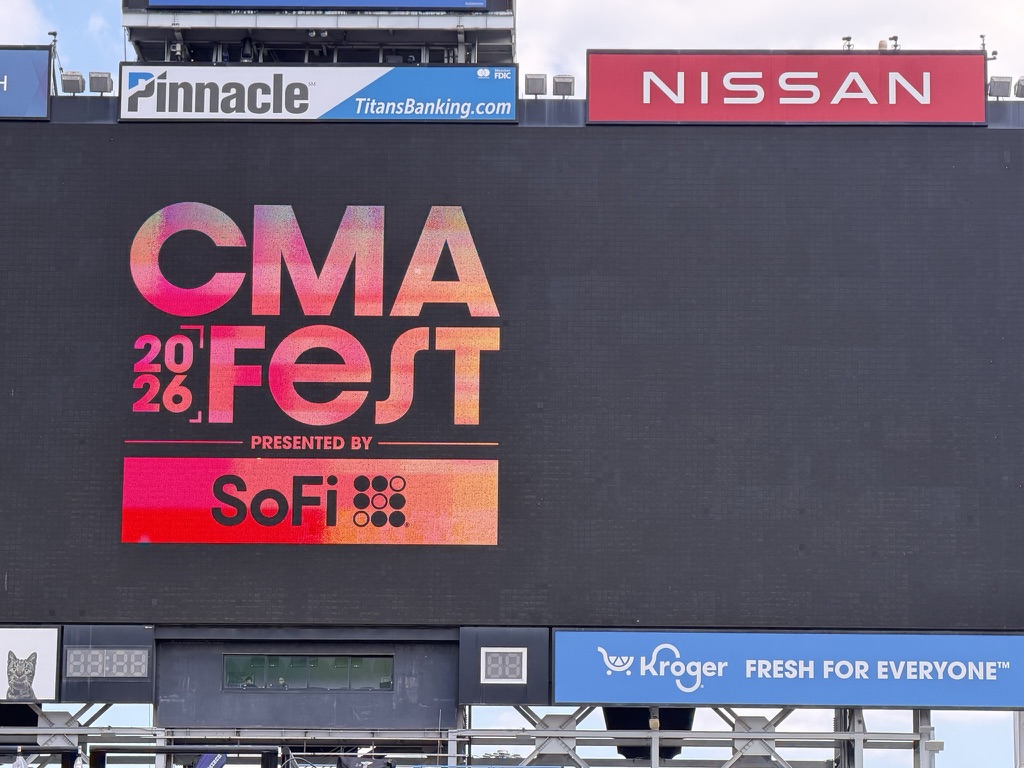
CMA Fest 2026. The last time that sign goes up at this address.
The Last Night
The last night of a four-day run at Nissan Stadium always has an energy to it — the crowd is fully locked in, the crew has found their rhythm, and there's a collective understanding that whatever this is, it's working. The last night of the last CMA Fest at the old building had something extra underneath that.
Sixty thousand people in a stadium don't know they're watching the final chapter of something. They're there for the music. That's exactly how it should be. But the people who built it, who called every transition, who loaded that stage in and turned it into what you see from the floor — some of them have been doing this here for a long time. There's a shared understanding among that group of what this run meant.
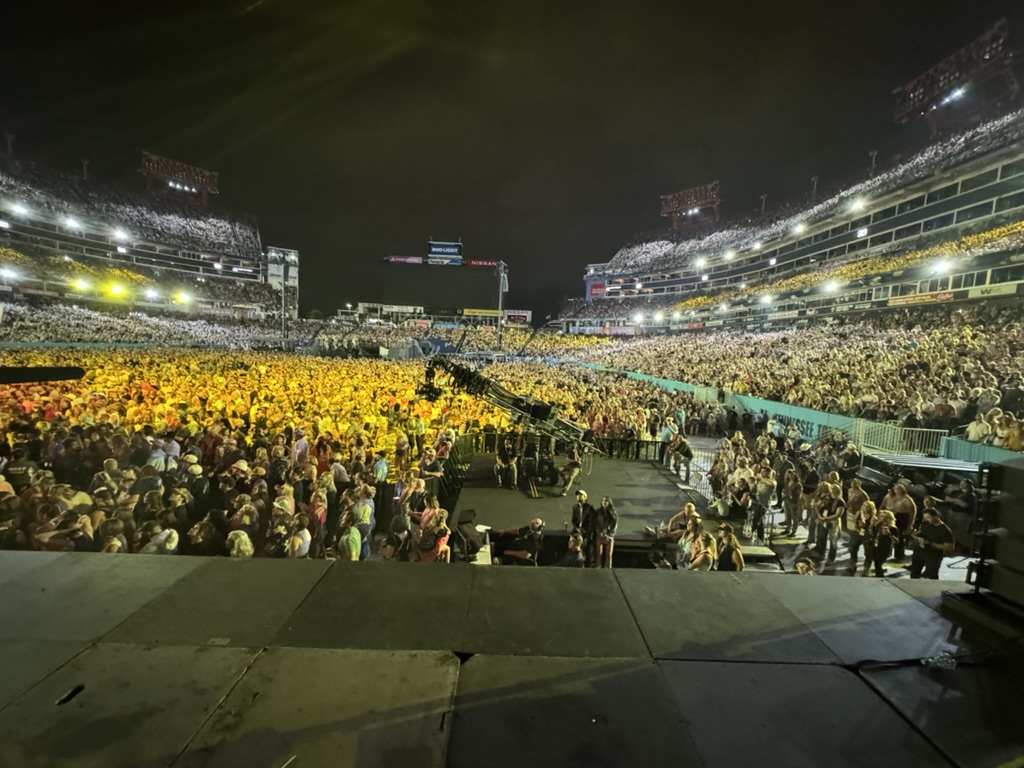
The view from backstage. Sixty-some-thousand people in a stadium who have no idea how much went into getting this moment right. That's the job.
2027: What Comes Next
I'll be honest — I'm genuinely excited about the new building.
The new stadium changes two things that have defined how we operate at CMA Fest for thirteen years: it's indoors, and it was designed as an entertainment venue first.
Indoors means no weather. That is not a small thing. June in Nashville is hot, humid, and prone to afternoon storms that can delay a show, threaten equipment, and put crew in difficult positions. Managing weather risk is a significant part of every production plan for this event. An indoor venue takes that variable off the table.
But the infrastructure piece is what interests me most professionally. Old Nissan Stadium was built for football. We adapted. Every year, we found creative solutions to the building's limitations — the dock count, the power distribution quirks, the access challenges that come with a structure that was never designed with a four-day music festival in mind. We got very good at working around things that shouldn't have to be worked around.
The new stadium is being built as an entertainment hub. The infrastructure is designed for what we do. Proper loading access. Power distribution built for production-scale events. Systems that don't require us to architect workarounds before we can do the actual work. That's the difference between operating in a building that accommodates you and operating in a building that was built for you.
"The new stadium was built as an entertainment hub that also doubles as a football field. The infrastructure is set up for what we do. No compromises because of the building."
We start building that institutional knowledge from scratch. Year one in a new building is humbling no matter how experienced the team is. There will be things we discover that aren't in the spec sheet. There always are. But discovering them in a building designed for events — rather than reverse-engineering solutions in a building designed for something else — is an advantage I'm looking forward to.
What the Old Building Taught Me
If you're coming up in production and you want one thing to take from thirteen years of doing the same event in the same place, it's this: know your building before you try to run a show in it.
Walk it before load-in. Walk the docks. Count them. Back a truck down the ramp yourself if you have to. Understand the cable paths. Talk to the building's operations staff — not just about permits and scheduling, but about how the place actually behaves under event conditions. Every building has a personality. The ones who perform best in a venue are the ones who've taken the time to understand that personality before showtime.
At Nissan, we spent thirteen years building that understanding. It made every successive year smoother than the one before it. That's not luck. That's the compounding value of knowing your environment deeply enough to stop being surprised by it.
The new building doesn't know us yet. But it will.
Pass It On
CMA Fest is one of the most demanding events in country music from a production standpoint. If you're working your way into large-scale festival production and you want to talk through what it looks like from the coordination side — the advance process, the crew management, the vendor relationships, the operational structure that makes a four-day stadium run work — reach out. This is the kind of work that gets better when people share what they know.
Thirteen years at the old building. Whatever comes next, the work is the same. Show up, prepare the site, take care of the crew, and give every artist the best possible version of their show.
See you at the new stadium in 2027.