Almost nobody in the building thinks about rigging. The audience doesn't. Most of the crew doesn't, beyond knowing points are up and gear is flying. But every truss, every motor, every video wall hanging over the stage got there because a small handful of people did the math right, checked it twice, and executed it under a clock.
Casey Crowe gets that better than most people with his experience level. He's in his second year as an LED tech and has started learning rigging on the side, because his team is responsible for hanging ten thousand pounds over the heads of people he works with every day. That's the whole job, distilled into one sentence from someone still climbing the ladder in our industry.
What Rigging Actually Is
David "Bones" Lowman runs our rigging department, and he calls it a babysitting gig. Not because the technical work isn't demanding... it is... but because so much of the job is vetting the local crew you're handed at every building. It's not just calculating loads. It's figuring out fast who on that local crew is qualified for what, before a single point goes into the air.
Rigging calculations happen almost entirely in advance. Walk and chalk exists to remove surprises, not create them. But buildings don't always match the CAD exactly, and when a point doesn't line up, the adjustments get prioritized by weight. Audio moves first and most often, because it's the heaviest.
Automated pieces complicate that further. If you move one element, you're not just relocating it, you're reassessing every load transfer and clearance change tied to it, because those pieces have fixed spatial relationships to everything around them.
Bones and Luther: The Walk and Chalk
Walk and chalk runs on a two-person rhythm that's been drilled into muscle memory. Bones builds the mark-out sheet. Luther Hicks, our assistant rigger, calls the numbers off it. Bones marks the floor to match, tape and chalk, point by point, working off what he's hearing rather than what he wrote.
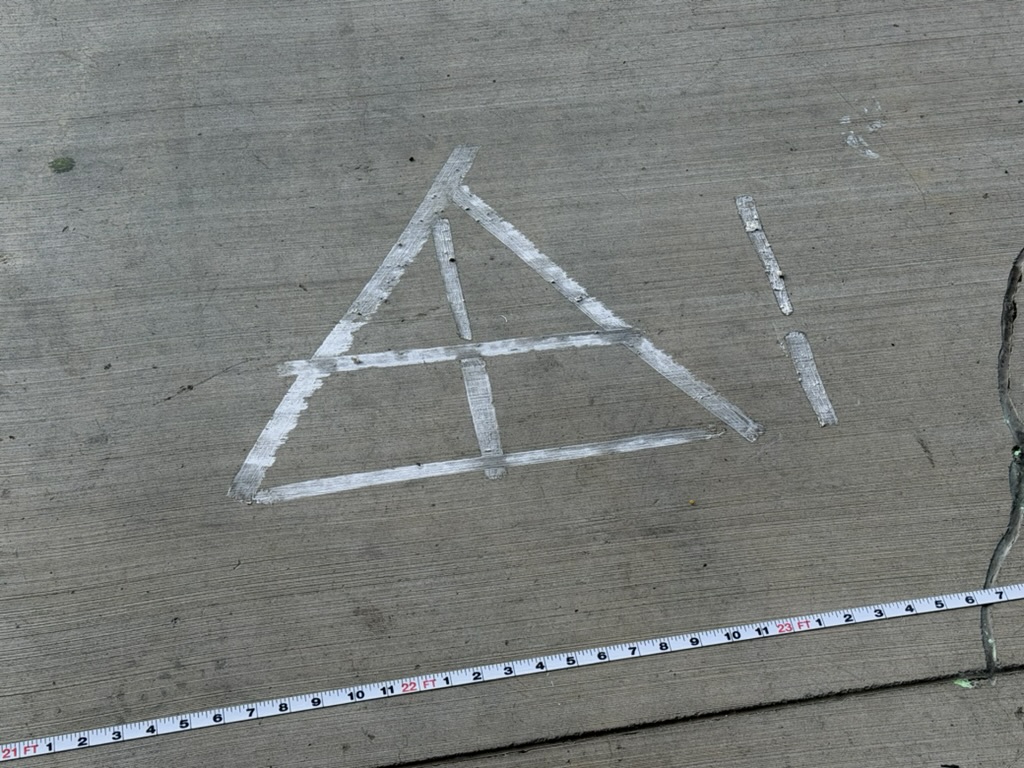
A hoist point marked out in tape and chalk. Precise to the inch, because the load above it isn't a guess.
That handoff is where a tour finds its footing. In the first few weeks, numbers get crossed... a 13-foot mark called when it should've been 15, that kind of thing. It's not sloppiness, it's just two people building a shared rhythm for the first time. By the back half of a run, the calls and the marks move fast and quiet, no wasted words between them.
The tools underneath it have changed even if the rhythm hasn't. Riggers used to run this math by hand, on notepads. Now the details get built on an app preloaded with venue bay specs, which speeds up the front end considerably. But the plan still meets the real building on the day, and duct locations, new weight capacities, and constraints particular to that room always require adjustment in real time. "Plan in perfection, execute in practice."
The Physics Nobody Thinks About
Here's a mistake that trips up even experienced people: assuming a thousand-pound truss spread across five points means two hundred pounds per point. It doesn't work that way. Middle points typically carry a higher percentage of the total load than the ones on the ends.
Our upstage video wall flies ten thousand pounds across six points, averaging out to roughly 1,666 pounds each... but that's an average, not a distribution. We use digital load cells to monitor the real numbers live, which matters most for catching a fast motor that's quietly picking up more than its share of weight. Automation adds another layer on top of that, since moving pieces introduce dynamic loads that need tighter monitoring than anything static.
Bones reminded me of a real example of exactly why that discipline matters. During preproduction and rehearsals with our automated video wall section... what the crew calls "the eyebrow," the piece that closes off part of the stage on top of our main riser... a vendor of ours gave us stated weights that didn't follow the math. That led to them supplying a half-ton hoist that turned out to be insufficient for the actual load. The load cells don't lie, and once the real numbers showed up, that vendor had to scramble to source larger hoists. Two days lost waiting on them to arrive and get implemented. Real time and real money, over weights that should have added up the first time.
I keep a load percentage chart, that Bones gave me, on my desktop for exactly this reason... a quick reference so nobody's guessing at a number that's "close enough". In rigging, close enough isn't an option.
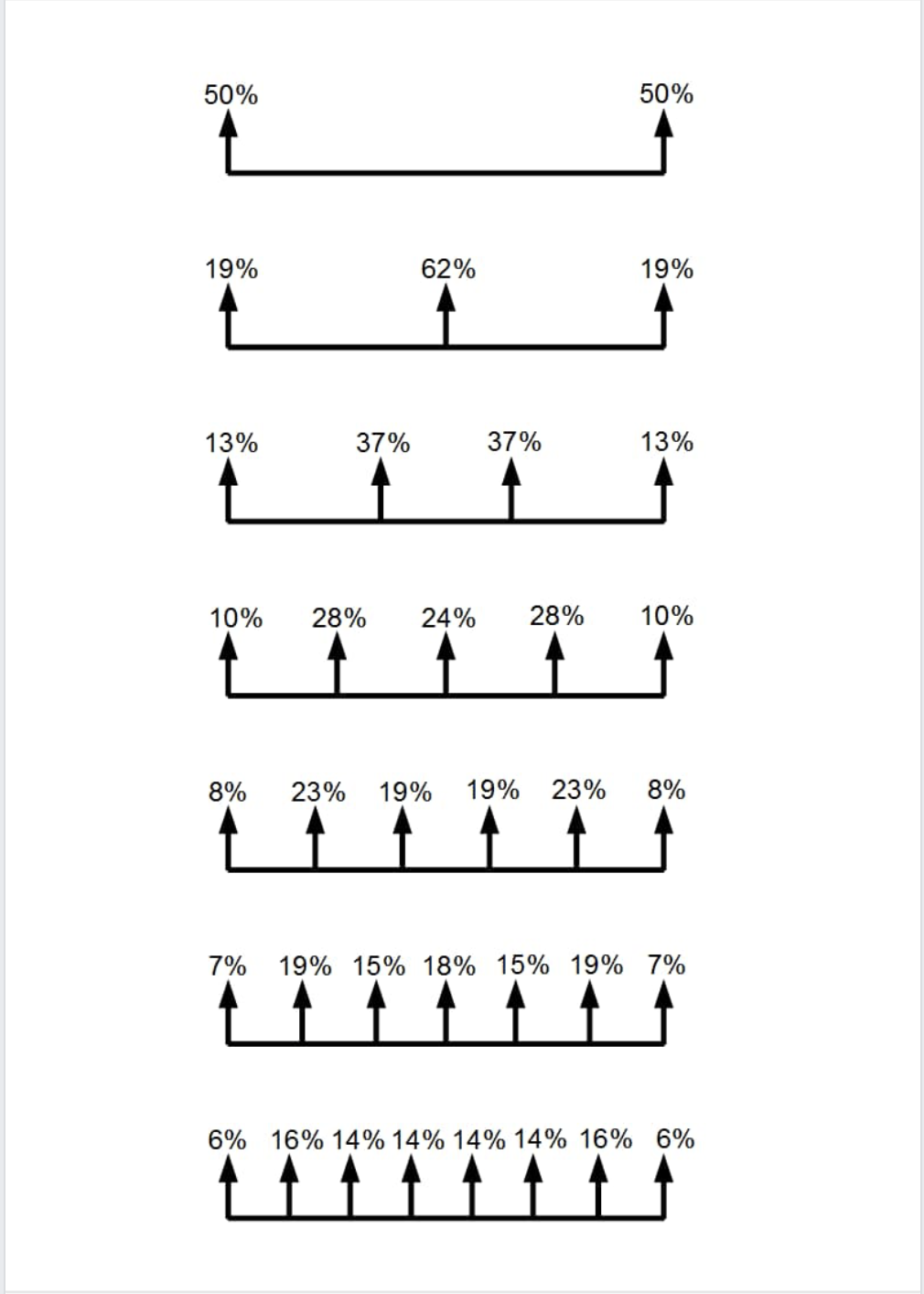
Load percentage across suspension points. The middle carries more than the ends... every time.
Arena vs. Amphitheater, On the Ground
A mark-out starts with a site assessment to figure out where the grid sits relative to the stage, then a center point, a center line, and parallel tapes marking design points across the floor. Call it twenty minutes of what Luther calls the arts-and-crafts phase before anything gets pulled into the air.
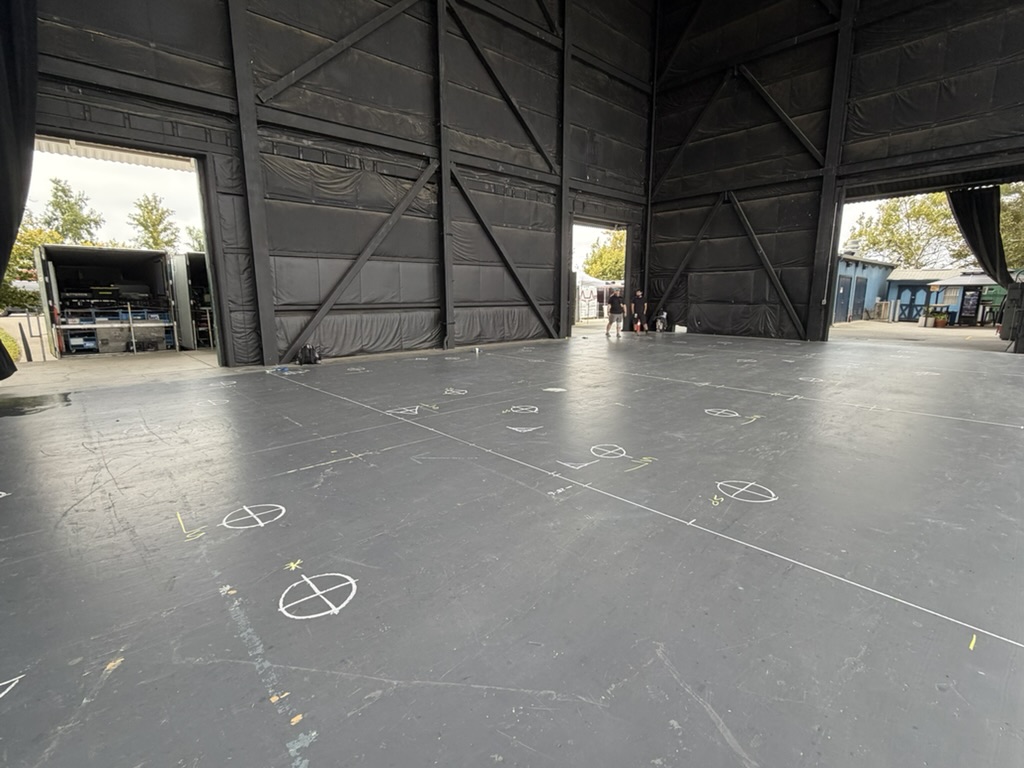
Twenty minutes of what Luther calls the "arts-and-crafts phase." Every mark goes down before a single point goes into the air.
Amphitheaters and arenas ask for different things once you're in that phase. Amphitheaters typically have narrower bay grids and lower trim heights, which means smaller steel packages and less hook height to manage. Arenas require more down legs, cutting down how much chain hangs in the air, but that comes at the cost of more total steel.
Datum points differ too. Amphitheaters use the poured concrete edge of the stage as a fixed zero-point. Arenas need more verification, since the stage itself could sit almost anywhere in the room. That verification isn't a technical nicety... if a stage gets built too far into the room, it can eat into the seating map and cost the venue a row of chairs they already sold. Once the show is built, there's no fixing that.
What Changed, and What It Cost
Fall protection is standard now in a way it didn't used to be. Bones is straightforward about the tradeoff that came with it. Once it became mandatory, less experienced people started entering the field who might not have otherwise, and injuries ticked up for a while as a result. Fall protection doesn't replace being fundamentally comfortable at height. It's a backup to that, not a substitute for it.
The industry also lost a lot of veteran riggers after COVID. People who'd been doing this for decades walked away and didn't come back. That gap in experience is still being felt on crews across the business.
1996: What Happens When the Math Is Wrong
Bones has a story from the 1996 Papal visit to New York City, when a space frame roof structure collapsed during a crane pick. The sequence was almost mechanical in how it went wrong. The crane picked the roof, swung it into position, and as it leveled out for placement, a load transfer occurred that nobody had calculated for. The nylon slings holding it were underrated for that new load, and they blew out. The entire structure came down.
There's no planning for failure in this job. The mindset is binary: the show happens, and nobody gets hurt.
That's the story that sits underneath everything else riggers do. The 1996 collapse is what it looks like when that binary breaks.
Casey Crowe: Learning to See It From the Steel
The hardest part of learning rigging isn't the math, according to Casey. It's the visualizing... understanding how a bridle wraps around a beam looks completely different from the ground than it does up in the steel. Even versus non-even bridles, baskets, the specific hardware that actually makes a point... none of it clicks on paper the way it does when you actually see it in practice.
He's working through Entertainment Rigging by Harry Donovan, standard reading for anyone serious about the craft. But mostly he's logging time watching Bones and Luther work, building the kind of instinct that eventually lets someone run a call instead of just executing one.
No Gray Area
There's almost no middle ground in how people understand this work. Either someone thinks it's just "hanging things up," or they've got real technical depth on bridles and load math. Almost nobody sits in between.
Most nights, the only time an audience notices the rig at all is when something moves. A wall flies in, a truss repositions, and people who assumed the whole rig was a static part of the building suddenly realize it was built and hung specifically for that show, that night, and it'll all come back down before the next city.
We walk into an empty box in the morning. We walk out of the same empty box that night. In between, we hung a show there. Only the fans know it happened.